Connect With Us
Items filtered by date: August 2025
Sunday, 31 August 2025 00:00
Are You Suffering From Ingrown Toenails?

If left untreated, an ingrown toenail can lead to more serious concerns, such as an infection. Knowing proper nail care can help in the prevention of an ingrown toenail. Give us a call, and get treated!
Tuesday, 26 August 2025 00:00
The Importance of Proper Footwear for Medical Professionals

For medical professionals who spend long hours on their feet, the right footwear is essential. Proper shoes can reduce pain, prevent injuries, improve posture and body alignment, enhance stability, reduce the risk of falls, and even boost professional confidence. Supportive, well-fitted footwear helps maintain comfort during demanding shifts, while protecting joints and muscles from strain. A podiatrist can assess foot structure, identify any underlying conditions, and recommend footwear or orthotics tailored to individual needs. Investing in proper shoes not only benefits physical health, but also supports better performance in patient care. If you have foot pain from wearing the wrong shoes, it is suggested that you consult a podiatrist who can treat various foot conditions, and provide you with expert advice on the proper shoes to wear for your profession.
While working on the feet, it is important to take the proper care of them. For more information about working on your feet, contact Ali Davis, DPM from The Foot Clinic. Our doctor will treat your foot and ankle needs.
Working on Your Feet
Standing on your feet for long periods of time can cause stress and pain in your feet. Your whole body may experience change in terms of posture, back pain, bunions, callouses and or plantar warts. There are ways to avoid these conditions with proper foot care, smart choices and correct posture.
Positive Changes
Negative heeled shoe – Choosing this shoe type places the heel slightly lower than the ball of the foot. These are great for overall foot health. Find shoes that fit you correctly.
Go barefoot – Our feet were not designed to be enclosed for all hours of the day. Try to periodically expose your feet to air.
Eliminate Pain
Foot Exercises – Performing simple exercises, incorporating yoga and doing stretches are beneficial. This will allow increased blood flow to the area and muscles of the foot.
Achilles tendon – Stretching the foot out flat on the floor will relax the calf muscles and tendon. These exercises can be performed almost anywhere. Make sure you add these exercises to your daily regimen.
With a little bit of this information and knowing more about foot health, you will notice changes. Foot stretches and proper footwear will help with pain and prevent further issues.
If you have any questions please contact our office located in Overland Park, KS . We offer the newest diagnostic and treatment technologies for all your foot and ankle needs.
Tuesday, 19 August 2025 00:00
Preventing Pickleball Injuries to the Foot and Ankle

Pickleball is a fast-growing sport that combines agility and quick movements, which can lead to foot and ankle injuries. Common pickleball injuries include sprained ankles, plantar fasciitis, Achilles tendonitis, and stress fractures. These often occur due to sudden direction changes, wearing improper footwear, or playing on hard surfaces. Preventing injury involves stretching before play, wearing supportive shoes, and allowing adequate rest. A podiatrist can evaluate your foot structure, recommend proper footwear, treat injuries, and guide recovery. If you experience persistent foot or ankle pain after playing pickleball, it is suggested that you promptly consult a podiatrist who can offer effective relief and prevention strategies.
Ankle and foot injuries are common among athletes and in many sports. They can be caused by several problems and may be potentially serious. If you are feeling pain or think you were injured in a sporting event or when exercising, consult with Ali Davis, DPM from The Foot Clinic. Our doctor will assess your condition and provide you with quality foot and ankle treatment.
Common Injuries
The most common injuries that occur in sporting activities include:
- Achilles Tendonitis
- Achilles Tendon Rupture
- Ankle Sprains
- Broken Foot
- Plantar Fasciitis
- Stress Fractures
- Turf Toe
Symptoms
Symptoms vary depending upon the injury and in some cases, there may be no symptoms at all. However, in most cases, some form of symptom is experienced. Pain, aching, burning, bruising, tenderness, tightness or stiffness, sensation loss, difficulty moving, and swelling are the most common symptoms.
Treatment
Just as symptoms vary depending upon the injury, so do treatment options. A common treatment method is known as the RICE method. This method involves rest, applying ice, compression and elevating the afflicted foot or ankle. If the injury appears to be more serious, surgery might be required, such as arthroscopic or reconstructive surgery. Lastly, rehabilitation or therapy might be needed to gain full functionality in the afflicted area. Any discomfort experienced by an athlete must be evaluated by a licensed, reputable medical professional.
If you have any questions please contact our office located in Overland Park, KS . We offer the newest diagnostic and treatment technologies for all your foot and ankle needs.
Tuesday, 12 August 2025 00:00
Arches of the Foot

The three arches of the feet support body weight and help absorb shock during movement. They are the medial and lateral longitudinal arches, which run from heel to toes, and the transverse arch, which spans across the midfoot. The medial arch is higher and more flexible, while the lateral arch is flatter and more stable. These arches are formed by the arrangement of foot bones and are supported by ligaments, tendons, and muscles, including the plantar fascia. The arches of the feet act like springs, allowing them to adapt to different surfaces and conserve energy when walking or running. When the arches are too flat or too high, problems like arch pain, heel pain, or pressure in the ball of the foot can result. A podiatrist can evaluate arch structure and function and prescribe orthotics or provide other treatment to improve comfort and mobility. If you are experiencing pain in the arch of the foot, it is suggested that you schedule an appointment with a podiatrist for an exam and appropriate treatment.
If you have any concerns about your feet, contact Ali Davis, DPM from The Foot Clinic. Our doctor can provide the care you need to keep you pain-free and on your feet.
Biomechanics in Podiatry
Podiatric biomechanics is a particular sector of specialty podiatry with licensed practitioners who are trained to diagnose and treat conditions affecting the foot, ankle and lower leg. Biomechanics deals with the forces that act against the body, causing an interference with the biological structures. It focuses on the movement of the ankle, the foot and the forces that interact with them.
A History of Biomechanics
- Biomechanics dates back to the BC era in Egypt where evidence of professional foot care has been recorded.
- In 1974, biomechanics gained a higher profile from the studies of Merton Root, who claimed that by changing or controlling the forces between the ankle and the foot, corrections or conditions could be implemented to gain strength and coordination in the area.
Modern technological improvements are based on past theories and therapeutic processes that provide a better understanding of podiatric concepts for biomechanics. Computers can provide accurate information about the forces and patterns of the feet and lower legs.
Understanding biomechanics of the feet can help improve and eliminate pain, stopping further stress to the foot.
If you have any questions please feel free to contact our office located in Overland Park, KS . We offer the newest diagnostic and treatment technologies for all your foot and ankle needs.
Tuesday, 05 August 2025 00:00
Helping Children With Clubfoot Lead Active Lives

Clubfoot is a condition present at birth in which the foot appears twisted or turned inward. Although it may look severe, early treatment often leads to excellent outcomes. Most interventions begin soon after birth, typically with a method that gently moves the foot into better alignment using a series of casts. This process, commonly known as the Ponseti method, gradually reshapes the foot over several weeks. In some cases, a minor procedure is needed to release a tight tendon in the heel. Once corrected, the child will wear a special brace for a period of time to maintain the results and prevent the foot from returning to its original position. Long-term follow-up care ensures proper development as the child grows. With early care and guidance from a podiatrist, most children with clubfoot go on to walk, run, and play without difficulty. If your child is born with clubfoot, it is suggested that you see a podiatrist as quickly as possible so treatment can begin.
Congenital foot problems require immediate attention to avoid future complications. If you have any concerns, contact Ali Davis, DPM of The Foot Clinic. Our doctor can provide the care you need to keep you pain-free and on your feet.
Congenital foot problems are deformities affecting the feet, toes, and/or ankles that children are born with. Some of these conditions have a genetic cause while others just happen. Some specific foot ailments that children may be born with include clubfeet, polydactyly/macrodactyly, and cleft foot. There are several other foot anomalies that can occur congenitally. What all of these conditions have in common is that a child may experience difficulty walking or performing everyday activities, as well as trouble finding footwear that fits their foot deformity. Some of these conditions are more serious than others. Consulting with a podiatrist as early as possible will help in properly diagnosing a child’s foot condition while getting the necessary treatment underway.
What are Causes of Congenital Foot Problem?
A congenital foot problem is one that happens to a child at birth. These conditions can be caused by a genetic predisposition, developmental or positional abnormalities during gestation, or with no known cause.
What are Symptoms of Congenital Foot Problems?
Symptoms vary by the congenital condition. Symptoms may consist of the following:
- Clubfoot, where tendons are shortened, bones are shaped differently, and the Achilles tendon is tight, causing the foot to point in and down. It is also possible for the soles of the feet to face each other.
- Polydactyly, which usually consists of a nubbin or small lump of tissue without a bone, a toe that is partially formed but has no joints, or an extra toe.
- Vertical talus, where the talus bone forms in the wrong position causing other bones in the foot to line up improperly, the front of the foot to point up, and the bottom of the foot to stiffen, with no arch, and to curve out.
- Tarsal coalition, when there is an abnormal connection of two or more bones in the foot leading to severe, rigid flatfoot.
- Cleft foot, where there are missing toes, a V-shaped cleft, and other anatomical differences.
- Macrodactyly, when the toes are abnormally large due to overgrowth of the underlying bone or soft tissue.
Treatment and Prevention
While there is nothing one can do to prevent congenital foot problems, raising awareness and receiving neonatal screenings are important. Early detection by taking your child to a podiatrist leads to the best outcome possible.
If you have any questions, please feel free to contact our office located in Overland Park, KS . We offer the newest diagnostic and treatment technologies for all your foot care needs.
Friday, 01 August 2025 00:00
Why Live with Pain and Numbness in Your Feet?
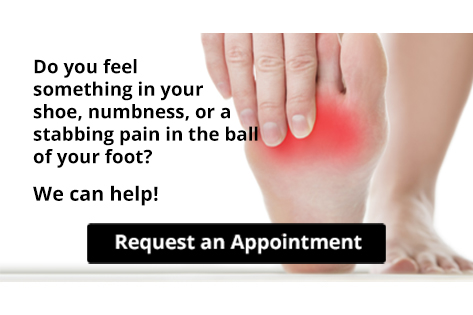
Suffering from this type of pain? You may have the foot condition known as Morton's neuroma. Morton's neuroma may develop as a result of ill-fitting footwear and existing foot deformities. We can help.
Blog Archives
- April 2026
- March 2026
- February 2026
- January 2026
- December 2025
- November 2025
- October 2025
- September 2025
- August 2025
- July 2025
- June 2025
- May 2025
- April 2025
- March 2025
- February 2025
- January 2025
- December 2024
- November 2024
- October 2024
- September 2024
- August 2024
- July 2024
- June 2024
- May 2024
- April 2024
- March 2024
- February 2024
- January 2024
- December 2023
- November 2023
- October 2023
- September 2023
- August 2023
- July 2023
- June 2023
- May 2023
- April 2023
- March 2023
- February 2023
- January 2023
- December 2022
- November 2022
- October 2022
- September 2022
- August 2022
- July 2022
- June 2022
- May 2022
- April 2022
- March 2022
- February 2022
- January 2022
- December 2021
- November 2021
- October 2021
- September 2021
- August 2021
- July 2021
- June 2021
- May 2021
- April 2021
- March 2021
- February 2021
- January 2021
- December 2020
- November 2020
- October 2020
- September 2020
- August 2020
- July 2020
- June 2020
- May 2020
- April 2020
- March 2020
- February 2020
- January 2020
- December 2019
- November 2019
- October 2019
- September 2019
